 The back of a 1968 photo from the New York Times archive, featured in the NYT's extremely promising new Tumblr, The Lively Morgue.
(thank you Kyle Johnson)
 The back of a 1968 photo from the New York Times archive, featured in the NYT's extremely promising new Tumblr, The Lively Morgue.
 The Kalakala, which operated as a ferry on Puget Sound from 1926–1967. Having been repurposed as a fish processing vessel in Alaska since its retirement, and now residing in Tacoma-WA, the Kalakala has fallen into severe disrepair. It is currently up for sale for $1 or best offer. More info here.
 Fragment of the original Star Spangled Banner, from Heritage Auctions' recent sale of Civil War memorabilia. The fragment was formerly in the possession of flag restorer Katherine Fowler Richey (1889-1949); her mother Amelia Fowler (1862-1923) was one of ten women who, for eight weeks, fastened the original Star Spangled Banner to a backing of linen using a stitch that Ms. Fowler patented in 1913.
 I've been doing some research recently and ran across this cool 1901 map of the Seattle waterfront. I think at this point everyone can agree that the government pretty much sucks, but you have to love the U.S. Geological Survey.
 Woody Allen outside Elaine's.
 Liza Minnelli, Andy Warhol and Bianca Jagger at Elaine's, 1978.
 Gay and Nan Talese at Elaine's.
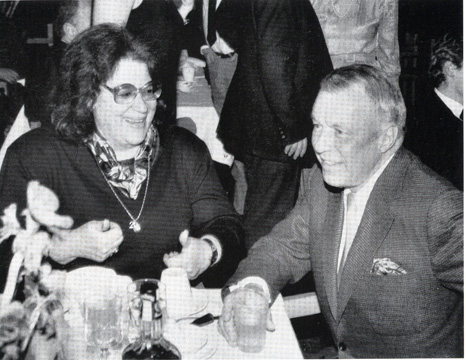 Frank Sinatra and Elaine ... at Elaine's.
 Chevy Chase, Dan Aykroyd, John Belushi and Lorne Michaels
 Sean Penn and Madonna at Elaine's, 1984.
 George Plimpton, Jared Paul Stern and Cameron Richardson at Elaine's, 1999.
 Interior at Elaine's.
 Olivier Zahm.
 Elaine Kaufman, who died on Dec. 3 of last year at age 81,
 Tom Carney, bartender at Elaine's.
 A student demonstrates at Pace College, NY, on the first Earth Day – April 22, 1970).
 Barack Obama in Hawaii with his grandfather, Stanley Armour Dunham, from an expansive article about the President's mother, Stanley Ann Dunham, by Janny Scott for this weekend's The New York Times Magazine.
 Derek Erdman moving to Seattle was one of the better things the city experienced in 2010. Tonight the Crocodile celebrates the 2nd anniversary of its re-opening with a new exhibition of his paintings and a party from 6–9PM. Go here for info and then go spend some quality time here.
 Forty years ago today Congress cancelled government funding for the Boeing 2707 (aka the SST – Supersonic Transport).
 The company almost immediately laid off more than 50% of its workforce, temporarily crippling the economy of the Pacific Northwest (though I know it didn't feel temporary). Real estate agents Bob McDonald and Jim Youngren erected this sign near the aiport on Highway 99 and it became a Seattle icon:
 KUOW aired an interesting show on the Boeing Bust this morning – click here to listen – and click here to watch a Braniff promotional video promoting supersonic travel: "You don't have to carry a passport, because a friendly computer already knows more about you than you do."
 This week Abe Books' rare book room pulls together a collection of books produced by visionary publisher Victor Gollancz. Here's what they have to say about him:
Gollancz (1893-1967) studied the classics at Oxford University and during World War I began his life in publishing when he joined Ernest Benn’s firm … recruiting writers [such as] Edith Nesbit and H. G. Wells. In 1927, he set up his own publishing house and his career took off. [Among others,] he signed George Orwell, Ford Madox FordDaphne Du Maurier.
...
Gollancz was ahead of this time. He placed full-page adverts for his books in newspapers (very rare for this period) and his designers established a recognizable style featuring powerful typography and yellow dust jackets. Gollancz was creating ‘branding’ 50 years before marketers embraced the buzzword.
In 1936, Gollancz was a co-founder of the Left Book Club with the intention of halting the growth of Fascism in Europe and promoting socialism. Every month, Gollancz recommended a left-leaning book and members received the book for a discounted price of two shillings and six pence. The first selection was France Today and the People's Front by Maurice Thorez, a French Communist. The Left Book Club had 45,000 members within 12 months and hundreds of local groups met and debated the books up and down Britain.
...
The publisher was knighted in 1965.
I cut out a lot, but the point, to make a long story short, is that Victor Gollancz was quite an interesting dude. Visit abebooks.com to learn more about him and browse.

 Skid Road, Murray Morgan's seminal history of Seattle, was first published on this day in 1951 – the 100th anniversary of the Denny party's landing at Alki Point*, which signifies the beginning of the city.
 Murray Morgan (right) and friends in Pioneer Square.
 The great State of Washington turns 121 years-old today. Above, an Asahel Curtis photograph taken in 1889, the year we achieved statehood, depicting the Griffith Davies book store on 1st Avenue between Cherry and Columbia Streets just before the great Seattle fire. As everyone knows, Washington went on to become the best state in the Union, trailed closely by (in approximate order) New York, California, Idaho, Maine, New Hampshire, Oregon, West Virginia, Vermont, Minnesota, Montana, Tennessee, North Carolina, Colorado, Wyoming, South Dakota, Pennsylvania, and Canada. Honorable mention but I have not been there: Alabama and Louisiana.
 You might not guess this from the topics generally covered on Pacific Standard, but I don't do a lot of gun-fighting. Still, I saw this book in the window of Twice Sold Tales (Capitol Hill) and could not pass it up.
 At the time of publication, Chic Gaylord was a holster maker in New York City, but, according to the introduction, "Chic's research-oriented mind has probed far beyond the holster, to the gun and gun fighting."
 "He brings to combat shooting the thinking of men who live with a gun twenty-four hours a day, seven days a week, month in and month out."
 "Many of his customers are men who have been in gun fights with well-armed opponents seeking to kill them, and they talk to Chic."
  Gaylord also profiles some of the most notorious gunfighters of the old West.
 The Rainbow Tavern, 1980
 Bartender Arlene Smith at the 5 Point, 1980
 Inside the DJ booth at Shelly's Leg, a gay bar under the Alaskan Way viaduct, 1976.
  Dear France,


