Cheap title, sorry. Some quick snaps from NYC last week....


Perfect man can kill a tarantula with a broomOne of the best shows I saw this past week in New York City.
in a businesslike manner, half-afraid.
Perfect man is the tarantula and the broom.
 Willem de Kooning, Woman IV, 1952-3.
 Jane Birkin photographed by Ezra Petronio for the new issue of Self Service Magazine. Age ain't nothin' but a number.
 Free Time Industries' 2012 Naturalist Almanac (Offset print, 23.5" x 23.5"), $43.
Starting at the center, the almanac tells you how to find the North Star, length of daylight, solstices, seasons, daylight savings, important days, living via the astrological signs, and keep track of moon and menstrual cycles. The almanac also gives seasonal information on topics such as hunting, fishing, foraging, building, health, gardening, raising ducks, weaving, raising bees, starting fires, and natural cleaning methods. The almanac is meant to be rotated at each season, creating a new ritual for the passing of time.Order it here.

 Kind of a controversial figure depending on who you ask, but no one would argue her influence on hip-hop, being the founder of Sugarhill Records. She died yesterday at the age of 75.
 Dries Van Noten Spring/Summer 2012. Really cool with shorts or short pants and a tan, IMHO.
 Images via style.com. I haven't had time to check out a ton of shows – and Emily has been completely swamped or she'd be posting this, or something like it – but Dries is one of my favorites so far. Here's the whole thing:
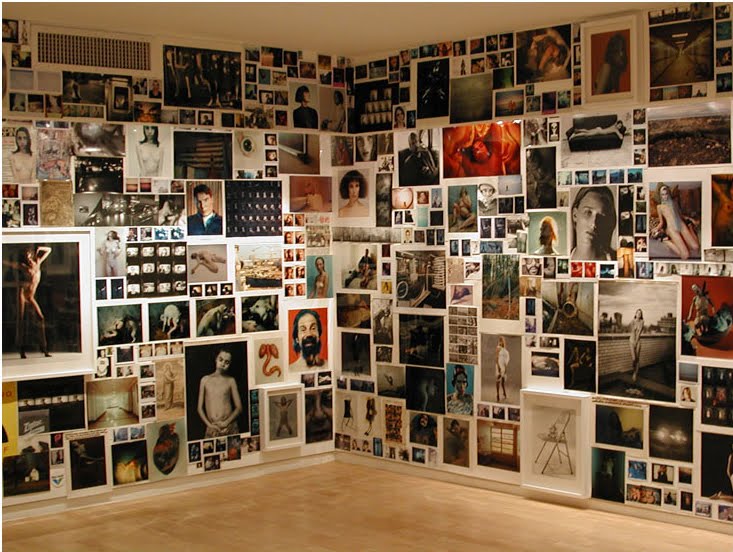
 Draw Blood for Proof is a forthcoming book by photographer Mario Sorrenti, to be published this December by Steidl.
Initially conceived as a personal project on the walls of Sorrenti’s New York loft, the material in Draw Blood for Proof eventually found its way onto gallery walls as a large-scale installation piece in 2004. Papering the site from floor to ceiling with layers of collected snapshots, contact sheets, prints, Polaroids and ephemera drawn from over fifteen years of work, Sorrenti’s collection was a unique look into the artist’s diaristic creative process, going beyond ideas of public and private production.Sorrenti is one of my favorite photographers, but he has published very few books, so I was excited to find out this is on the way. More info at Steidleville.


 Milton Resnick: Last Elephant, 1979 (Oil on canvas, 51 x 81 inches) – at Cheim & Read Gallery in New York through October 29th.

The Raincoats' second album, Odyshape, has long been a personal favorite, a record of strength through failure and of constructing new landscapes from pieces of puzzle whose shapes do not make logical sense, but whose emotional resonances sound deeply. Released in 1981, the group had lost drummer Palmolive before the start of the recording; her primal rhythms were one of the defining elements of the group's debut, and rather than try to replicate her attack here, they instead left her sonic space vacant, constructing songs out of many small, interlocking bits of rhythm, often played on instruments mostly unfamiliar to the band. Many African percussion instruments were used, with kalimbas and balafon utilized throughout, and the girls often swapped instruments as well, adding a greater sense of foreign unfamiliarity to the sounds created. The results were, and remain, striking; folk forms, both of an English and African variety, dominate, but nothing can be traced back to record-collector roots in the way a group like the Slits' love for dub reggae and Afrobeat left such distinct fingerprints on their own catalogue. This album remains one of the most unique and truly forward-looking records of the post-punk era in that it sees the Raincoats creating a new language out of personal need rather than gain; traditional songforms are recognized but never subscribed, and guest appearances by percussionists Robert Wyatt and This Heat/Camberwell Now's Charles Hayward give a nod to the era's other reconstructionists who worked in realms where the personal and political were held with balanced weight, and whose own works from this period (namely Wyatt's Old Rottenhat and Camberwell Now's The Ghost Trade albums) mine similar territory. It's hard to imagine someone like Tune-Yards or even St. Vincent making albums like their last respective works without giving a nod to the bridges built by the Raincoats, and Odyshape is one of the most important yet overlooked pieces of the band's discography.More on The Raincoats here.
 Calvin Klein SS2012 runway.
 Cool photos by Matthew Kristall for The Moment.
 Lisette Model: Sammy's Bar, 1945 (Gelatin silver print, 19 5/8 x 15 1/2 inches) on view at Bruce Silverstein Gallery through November 12th as a part of the show Self Reflections: The Expressionist Origins of Lisette Model.
 Lightning People is the debut novel by Christopher Bollen, who I used to work with at V Magazine. Can't wait to read it. If you're in NYC, he'll be appearing tomorrow at 7PM at Barnes & Noble Union Square, along with the electrifying Eleanor Friedberger (Fiery Furnaces), who will perform songs from her recent solo album, Last Summer.
 Willem de Ridder: European Mail-order Warehouse/Fluxshop, Winter 1964–65. From the show Thing/Thought: Fluxus Editions, 1962–1978, today through January 16, 2012, at the Museum of Modern Art, New York. More info here.

 I picked this copy up on a roadtrip through Halifax. Anyway, like I say, kind of cheesy but a pretty listenable album and I recommend picking it up if you find it.
 I forgot to post these final photos from our San Juans trip.
 On our last day we got in really late and decided we'd just stay the night at the dock in Everett. These are from the next morning, when it was really foggy and cold, and the current was going haywire.
 This beautiful sailboat was parked in front of us. The whole thing is just navy blue, white, wood, and stainless steel, and I liked the type on the title, Osprey.
 On kind of the other side of the spectrum, this boat is called the White Wind. Do you know how white you'd have to be to name your boat the White Wind?
 Eastern Hunter (New Bedford, Mass), sister of Fate Hunter (Astoria, Oregon)
 We made coffee at the dock on our small propane stove. Later in the morning Emily fell and dislocated her shoulder. But it was still kind of a fun morning (that aside, obviously).


 A classic white suit. (For instance, this one:
 GAAG: The Guerrilla Art Action Group, 1969-1976: A Selection, first published by Printed Matter in 1978, and now back in print. From the press release:
The book serves as the primary text to the significant work of the activist artist group GAAG (Jon Hendricks, Poppy Johnson, Silvianna, Joanne Stamerra, Virginia Toche and Jean Toche), both as a document of the group’s ideological and logistical concerns, and more broadly as a historical record for 52 of the many political art actions they carried out through the late Sixties and early Seventies.Get more info and order the book here.
Guided by their belief that art and culture had been corrupted by profit and private interest, GAAG formed in October 1969 as a platform for social struggle. Their work asked how artists could work effectively towards meaningful change, most often through direct provocation and confrontation—symbolic, non-violent actions staged in protest and ridicule of the ethical failures by the art and media establishments, as well as the US government. Their activities defied the brutal, close-minded workings of an artistic/political system that traded in dirty money, served the elite, established a trivial cultural canon, and perpetuated bloody wars abroad.
GAAG: The Guerrilla Art Action Group, 1969-1976: A Selection collects the manifestos, letters and press communiqués issued by the group to Nixon, Hoover, The Secretary of Defense, museum officials, and others. Their missives are printed as facsimiles, alongside other print material, including handwritten expenses, and related documents, that stand as statements of purpose and protest. Photographers Ka Kwong Hui, Joanne Stamerra, Jan Van Raay and others were often on hand as many of the actions unfolded, offering a remarkable and candid visual history to the group’s activities and confrontations.
Perhaps best known of the group’s actions is the unsanctioned 1969 event in The Museum of Modern Art, sometimes referred to as “Blood Bath.” Members of the group—Hendricks, Johnson, Silvianna and Jean Toche—gathered in the museum lobby, threw manifestos in the air, ripped each other’s clothing, spilling animal blood hidden beneath, while moaning and screaming. They dropped to the floor, writhing in the blood and manifestos as visitors and guards stood by. After the action, they got up and abruptly left the museum without addressing anyone. The manifestos demanded the resignation of the all the Rockefellers from the MoMA Board, and made clear the financial ties of the Rockefellers to the Standard Oil Corporation and McDonnell Aircraft Corporation, both then involved in weapons production for the Vietnam War.
 Crosley Spinnerette turntable, $150 at Dijital Fix. It plays and digitizes, and looks cool across the room from your Olivetti Valentine. Kind of Need but mostly just Want.


