. Ezra Stoller (American, 1915–2004): Chamberlain Cottage – Walter Gropius, Marcel Breuer, Wayland, MA 1942 (Gelatin Silver Print) on view through February 12 at Yossi Milo Gallery in New York as part of a retrospective of Stoller's photographs of iconic modern architecture. From the release:
A pioneer in the field of architectural photography, Ezra Stoller was commissioned by architects such as Frank Lloyd Wright, Paul Rudolph, Eero Saarinen, I.M. Pei, Marcel Breuer and Richard Meier [and Northwest modernist Arthur Erickson -ed.], because of his unique ability to capture the building according to the architect’s vision and to lock it into the architectural canon. His photographs convey a three-dimensional experience of architectural space through a two-dimensional medium, with careful attention to vantage point and lighting conditions, as well as to line, color, form and texture.
.The Barneys windows downtown are really cool right now, they all have fluorescent lightbulbs wrapped in colored cellophane. This photo doesn't really do it justice and I actually think the Lanvin window is my favorite, I just snapped this quickly yesterday on the way to a meeting. Anyway they're worth a look if you're downtown – I might take some more pics if I get the chance. (See some process shots at our friend Ashley's blog – she works on the Barneys windows.)
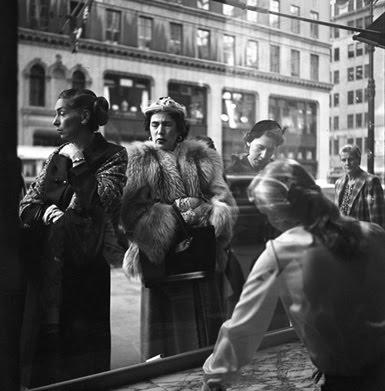
. Vivian Maier, a heretofore unknown street photographer who died two years ago at the age of 83, is the subject of a new solo show that started this past Friday at the Chicago Cultural Center.
The story of Maier's discovery is a romantic one for all the thrifters and flea-marketers among us. In 2007, John Maloof, then a 26-year old real estate agent who was working on a book about his Chicago neighborhood, stumbled upon a trove of over 100,000 of Maier's negatives at an auction, and set about scanning, preserving, and introducing the images to the world, while slowly piecing together the photographer's biography.
Maier was born in New York and worked as a nanny in Chicago for 40 years, beginning in about 1956. In her spare time she traveled the streets, mostly in Chicago and New York, with her camera. It's too early to say what position she'll ultimately occupy in the canon of modern photography, but either way that doesn't really affect the power of her photographs. They capture the people and scenes of an era with a clear eye for the humor and pathos of a moment, and a tangible sense of the weight, and fragility, of the human condition.
It was hard to choose just a few to include here. See more images at Maloof's blog, and watch a piece about Maier's work below.
[hat tip to friend, and friend of the blog, Kristina]
The Sartorialist: A Visual Life is a short documentary on Scott Schuman, aka street fashion photographer The Sartorialist, by Acne Production for Intel.
. A few spreads from issues 4 and 5 of Club Donny, a "Strictly Unedited Journal on the Personal Experience of Nature in the Urban Environment." The magazine solicits photographs through its web site, and prints and binds them as a stack of double-sided posters, allowing readers to flip through the publication or remove individual posters to view them in full.
Morris Cohen in 1971, in the University of Pennsylvania law library. Photo by Israel Shenker for the New York Times.
I try not to talk about my day job as a law librarian much on this blog, because, well, that's not what this blog is about. But - and in spite of the abundance of obits around here lately - I feel like I'd be remiss in not taking note of the recent passing of one of the profession's great lights: Morris Cohen, former director of the law libraries at Yale, Harvard, Penn and the University of Buffalo (now SUNY), and at the time of his death a professor emeritus at Yale law school. Morris is one of those people about whom anything that is said risks coming off as an understatement, inadequate, and fundamentally unworthy - especially by someone as young in the profession as I am. (I never met Morris but I feel like I can call him by his first name because I almost have the sense that I know him at this point, and because . . . well, just look at the man.) Suffice it to say that he is pretty much the Godfather of modern law librarianship, and clearly beloved by everyone who had the privilege of making his acquaintance.
The title of this post is also the name of one of the many texts he authored, and the one that I first cracked when I started my advanced legal research class in law school almost 10 years ago to this day. Its definitive tone pretty much sums up what an unquestionable lion of the profession he was. To the law library community this is something like the passing of Ted Kennedy, Johnny Cash, and Picasso all rolled into one. Rest in peace, Morris. There's no danger you'll be forgotten.
The obit from the New York Times (which also published an editorial tribute to Morris Cohen today) is here. My favorite part is the concluding paragraph:
As evidenced in his research, Professor Cohen had a penchant for the quaint and the quirky. At the University of Pennsylvania, where he taught legal bibliography from 1963 to 1971, a student once typed her term paper on onion skin and squeezed it into a walnut shell. He gave her an A.
. Not much of a surprise, but French Vogue announced today that Emmanuelle Alt will succeed Carine Roitfeld as the publication's Rédactrice en Chef.
[via style bible]
Going through past issues of the magazine recently to review Carine's time at the helm – more on that later – made me consider just how much Emmanuelle's sensibility has contributed to its unmistakable viewpoint. (I use first names as if I know these women personally....) A few snaps of Mlle. Alt's personal style, courtesy of the magazine's website:
. TheU.S. Postal Service announced its new stamp designs for 2011 last week, and this is my favorite:
Pioneers of American Industrial Design honors twelve of the nation's most influential industrial designers from the mid-20th Century: Frederick Hurten Rhead, Walter Dorwin Teague, Norman Bel Geddes, Raymond Loewy, Donald Deskey, Gilbert Rohde, Greta von Nessen, Russel Wright, Henry Dreyfuss, Peter Müller-Munk, Dave Chapman, and Eliot Noyes. The series will be available in July, 2011.
Truth be told, I'm still kind of mad at the post office right now – I haven't received some books I ordered and I'm pretty sure it's their fault – but nice postage stamps make me want to hug them anyway.
. Victoria Haven: There's No Place Like Home, 2010 (Ink on paper, 60 X 70 inches), at Greg Kucera Gallery in Seattle tonight through February 19. Click here for more info and images from the exhibition, and visit Victoria Haven's website at vichaven.com.
Gerry Rafferty "Baker Street" from City to City (United Artists, 1978)
Scottish singer/songwriter Gerry Rafferty passed away yesterday at the age of 63. I can't say I was the hugest fan, just in that I'm not that familiar with most of his work, but he holds a special place in my heart. When I was a kid, my dad, who is a woodworker, had his first shop in Totem Lake. Sometimes when he went there on the weekends my brother and I would get to go with him – we'd ride our bikes around the industrial park and there was a little stream that ran parallel with the driveway (possibly just slightly polluted) that we'd mess around in, before they fenced it off. A Husqvarna dealership was on the opposite end of the building, and being obsessed with BMX, we thought those dudes were scary and cool. In the shop next door to my dad's, his friend Rex was building a 39-foot sailboat by hand. If it was raining and we couldn't ride bikes, we'd go inside and nail wood together.
On the way back home we would often split a can of 7-Up (or Country Time, or Green River, if my brother and I had our way) and listen to KJR or KZAM. When the song "Baker Street" would come on I remember we all really loved it, and at some point this love reached critical mass and we went to the record store (I think maybe Budget Tapes & Records in Bellevue) and picked up the album.
I still have that record, and I'm probably biased, but I think it holds up pretty well today.
.Todd Hido: 9050, 2009 (Chromogenic print, edition of 5, 30 x 38 inches). Part of a new exhibition of Hido's photographs, Fragmented Narratives, at Bruce Silverstein Gallery, this Thursday night through February 12. Info and more images here.
In the course of mining our library for images to include in our New Year's post, I came across Francesco Scavullo's portrait of artist and fashion editor Bridget Tichenor. This photograph was taken in 1978, when Tichenor was 61. Gorgeous! I now have the definitive blueprint for styling my later decades.
Tichenor was the subject of the 1985 documentary short Rara Avis, directed by Tufic Makhlouf. Part one is below; two and three are after the jump. (The imagery makes it totally worthwhile, even if you don't speak Spanish.)
. Les Krims: Two Beauticians with Strange Hairstyles Pretending to be Interested in Science, Buffalo, New York, 1978.
When I first heard about Krims from Seattle-based photographer Kyle Johnson, very little of Krims' work was on the web, and his books were (and remain) extremely hard to come by. Now he has re-launched a website with a cross-section of mostly conceptual work from the '60s, '70s, and '80s, and an interview by Ken Miller (Tokion). I am still holding out hope for finding some of the books but this is a great reminder.
Visit leskrims.com for more info and images (including prints available for purchase).
I'm not 100% on this one – Netflix yes, theater doubtful – but director Miguel Arteta has a good track record (The Good Girl,Youth in Revolt) so I'm looking forward to seeing it. Plus, Clay Davis:
Pacific Standard issue no.1 covers: top, Abby Brothers by Michael Donovan; bottom, Alexis Schuster by Charlie Schuck. Select image above for more information.

 Ezra Stoller (American, 1915–2004): Chamberlain Cottage – Walter Gropius, Marcel Breuer, Wayland, MA 1942 (Gelatin Silver Print) on view through February 12 at Yossi Milo Gallery in New York as part of a retrospective of Stoller's photographs of iconic modern architecture. From the release: