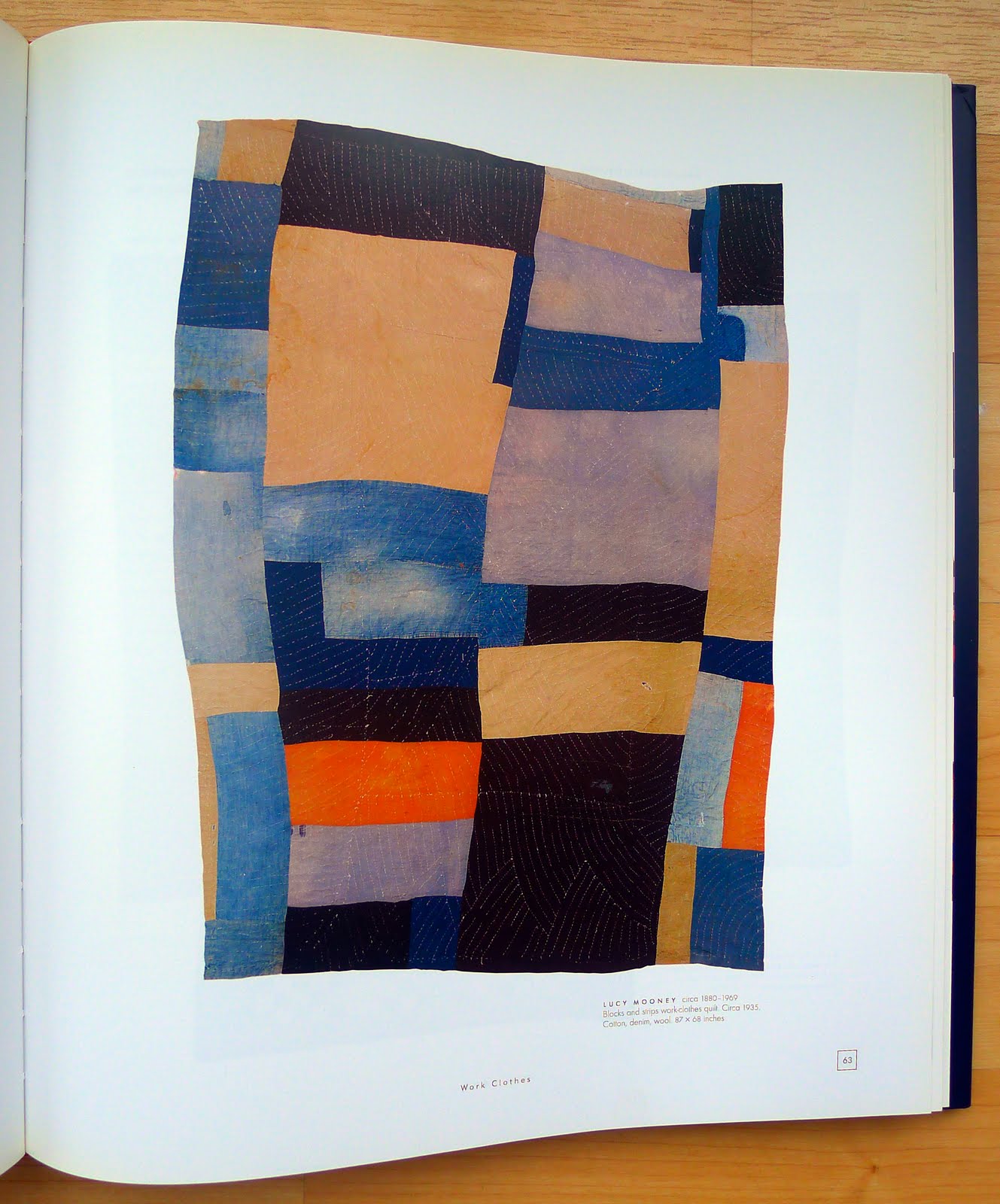
Continuing with the abstraction theme this week, The Quilts of Gee's Bend (Tinwood Books, 2002; monograph for exhibition of the same name).


We saw this exhibit when it traveled to the Whitney from the Museum of Fine Arts in Houston, and it was pretty fantastic. The older quilts radiated a beautiful sense of time and experience, and the color or the boldness of the lines in others made you feel like you could be looking at a Motherwell or a Rothko. It's strange then to realize that in just about every way the intent behind the work and the lives of the women who made – and continue to make – these quilts could not be further removed from anything going on in the mainstream art world.
Art lives everywhere.

(I am in a rush to leave town for the holiday, so I will have to
insert captions and credits later...apologies to the artists!)
insert captions and credits later...apologies to the artists!)


"Gee's Bend" in its narrowest usage describes a geographical feature: one of several "bends" where the Alabama River makes an abrupt, looping turn. More broadly, Gee's Bend is the traditional but unofficial name of a small African American community centered at the town of Boykin and encircled by the river. -- Alvia Wardlaw (from the Introduction)

What nature created at the Bend, history has reinforced. Its people were all but forgotten after emancipation, subsisting from generation to generation as sharecroppers and tenant farmers for absentee white landlords....Isolation has spawned a mythology unique to Gee's Bend. Well into the twentieth century, the settlement was regarded as a throwback: an antebellum artifact, even an Alabama Africa. -- John Beardsley (from the essay "River Island")


The quilts are products of the brilliant originality that lived through the dark eras of slavery and Reconstruction. ...The [quiltmakers] are descended from generations of slaves who worked the Pettway plantation at Gee's Bend. The ancestors of these artists were so firmly rooted in that place that they stayed put on that peninsula in Alabama after the Civil War and established a tightly knit community that during the Great Depression was declared one of the poorest place in the United States and singled out for federal relief programs. -- Peter Marzio, Director, The Museum of Fine Arts, Houston (from the Preface)


Studying the quilts of this small community called Gee's Bend, one quickly realizes that they embody a strangely independent, or self-referring, aesthetic. To a certain audience, they may reverberate with the rhythms and patterns of other twentieth-century art, whether the German Bauhaus-inspired work of Josef Albers or Paul Klee, some of Barnett Newman's compositions, or more contemporary painters such as Sean Scully. Yet these parallels quickly seem irrelevant. To claim too much "originality" would be pointless – and yet it is equally fruitless to attempt to establish actual influences from other art...Our fascination with these quilts lies in part in the impact they have on modern "high art," yet the quiltmakers of Gee's Bend cannot be shown to be directly, or for that matter indirectly affected by the mainstream art world. -- Jane Livingston (from the essay "Reflections on the Art of Gee's Bend")


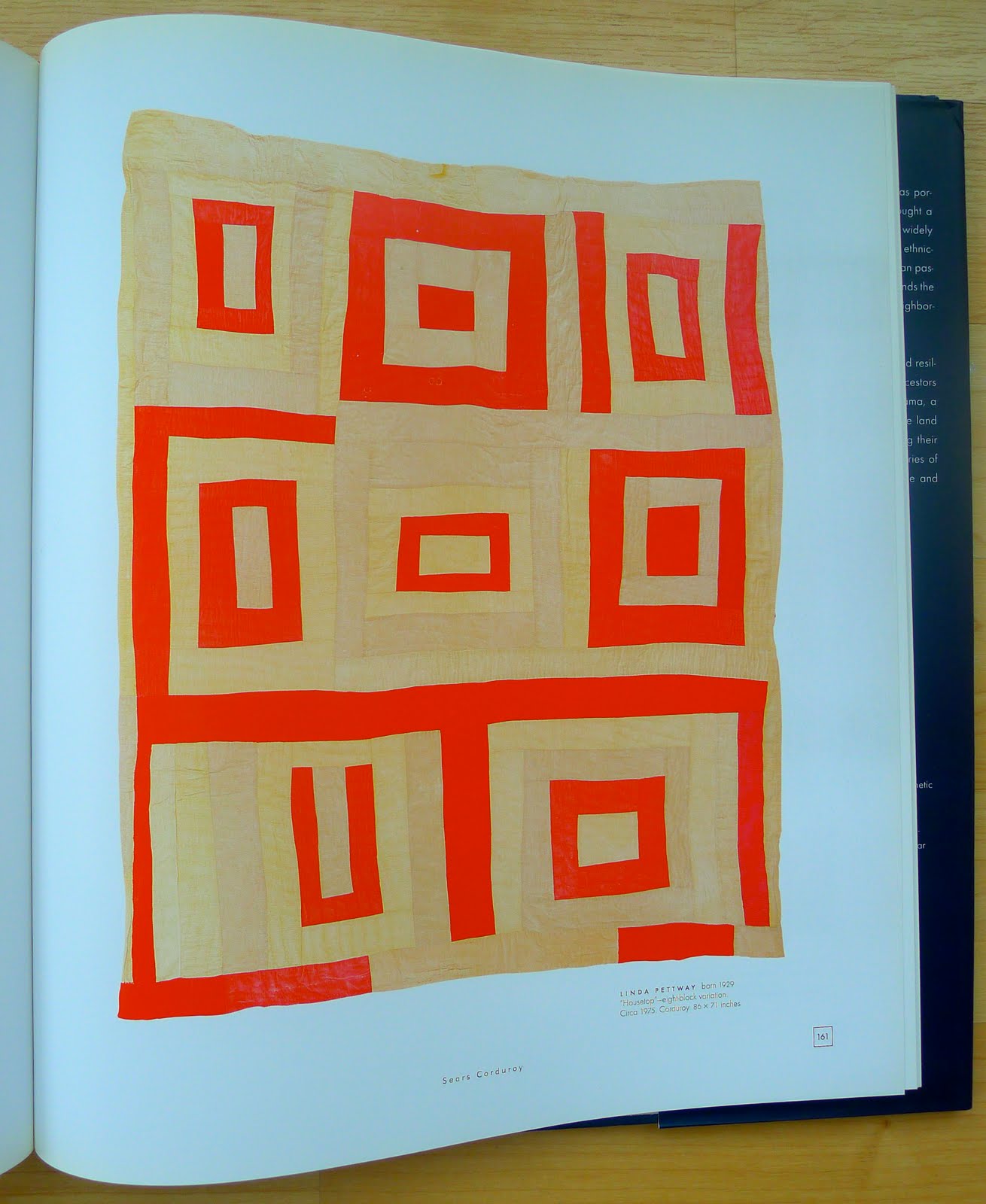
[T]he Gee's Bend aesthetic . . . is as inventive as the town's social history is intricate. . . . [A] totally unselfconscious approach to the act of making art prevails …. This is an aesthetic of the here and now. An unabashed immediacy permits the women to make snap decisions about a quilt and move on, sharing their decision-making with us. Theirs is an aesthetic of contemplation, but not hesitancy. The results are large-scale geometric permutations of pure color and form-bars and bands of color offered up in bold confidence, intricate triangles playing visual eye games.... -- Alvia Wardlaw (from the Introduction)


Working with "useless" bits of cloth, these artists seem to follow linear patterns–a classical path to beauty. But they also show a profound color sense that is as refined as that of any professional artist. The women know one another's styles as confidently as Jackson Pollock knew his as compared to Willem de Kooning. These women learn from one another but strive to be themselves. Their quilts are both the signatures of individuals and the banners of a community. -- Peter Marzio, Director, The Museum of Fine Arts, Houston (from the Preface)