
 Isabel Marant Spring 2011.
From the looks of it, soon to be available at net-a-porter
(possibly with the option of a higher heel?
which would be wonderful).
 Isabel Marant Spring 2011.
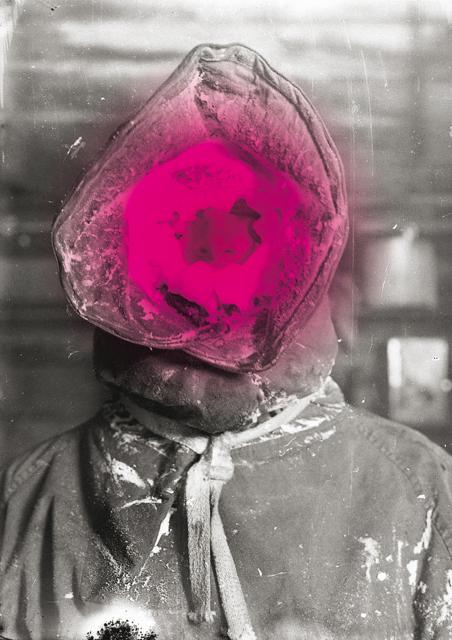 Patrick Tuttofuoco: Ice Mask, 2009 (Inkjet print, 42 x 29.7 cm), from Those Ghosts, a two-person exhibition featuring work by John Kleckner and Tuttofuoco at Peres Projects, Hamburg. More info here.


 Gilbert & George, Any Port in a Storm, 1973 (Mailed exhibition announcement card)
 Stephen Kaltenbach, Build a Reputation, 1969 (Magazine ad)
 Richard Serra, Lead Shot, 1970-71 (Magazine insert)
Why call these text pieces sculptures? Many of the artists defined their text work as sculpture and referred to it, both explicitly or implicitly, in their titles. Moreover, typical of art of this era, all of these works are concerned with the physical and conceptual place of the art object and the object of art in the real world. By the early 1960s music, film, dance and other forms of performance were infiltrating the visual arts, even as the rigid distinctions between painting and sculpture were crumbling in works such as Robert Rauschenberg’s combines and Jasper Johns’ object paintings. Sculpture, however, was still the de facto mental model for artworks designed to occupy, and exist in, real space—as opposed to hanging on walls as representational windows onto something else. What the artists making text sculpture realized was that working with ideas in the form of language allowed them the conceptual freedom required for rapid, inexpensive, logistics-free prototyping. There is no space in which an idea cannot be installed, no material of which it cannot be made, no shape it cannot assume, no conceptual feat it cannot attempt.
 N. E. Thing & Company Ltd., IT, 1966 (Mailed exhibition poster)
 Ezra Stoller (American, 1915–2004): Chamberlain Cottage – Walter Gropius, Marcel Breuer, Wayland, MA 1942 (Gelatin Silver Print) on view through February 12 at Yossi Milo Gallery in New York as part of a retrospective of Stoller's photographs of iconic modern architecture. From the release:
A pioneer in the field of architectural photography, Ezra Stoller was commissioned by architects such as Frank Lloyd Wright, Paul Rudolph, Eero Saarinen, I.M. Pei, Marcel Breuer and Richard Meier [and Northwest modernist Arthur Erickson -ed.], because of his unique ability to capture the building according to the architect’s vision and to lock it into the architectural canon. His photographs convey a three-dimensional experience of architectural space through a two-dimensional medium, with careful attention to vantage point and lighting conditions, as well as to line, color, form and texture.Visit Yossi Milo Gallery in person or online for more images and info.
 The Barneys windows downtown are really cool right now, they all have fluorescent lightbulbs wrapped in colored cellophane. This photo doesn't really do it justice and I actually think the Lanvin window is my favorite, I just snapped this quickly yesterday on the way to a meeting. Anyway they're worth a look if you're downtown – I might take some more pics if I get the chance. (See some process shots at our friend Ashley's blog – she works on the Barneys windows.)
 The story of Maier's discovery is a romantic one for all the thrifters and flea-marketers among us. In 2007, John Maloof, then a 26-year old real estate agent who was working on a book about his Chicago neighborhood, stumbled upon a trove of over 100,000 of Maier's negatives at an auction, and set about scanning, preserving, and introducing the images to the world, while slowly piecing together the photographer's biography.


 Maier was born in New York and worked as a nanny in Chicago for 40 years, beginning in about 1956. In her spare time she traveled the streets, mostly in Chicago and New York, with her camera. It's too early to say what position she'll ultimately occupy in the canon of modern photography, but either way that doesn't really affect the power of her photographs. They capture the people and scenes of an era with a clear eye for the humor and pathos of a moment, and a tangible sense of the weight, and fragility, of the human condition.


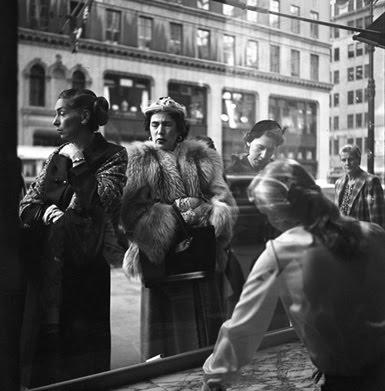 It was hard to choose just a few to include here. See more images at Maloof's blog, and watch a piece about Maier's work below.
Watch
the full
episode. See more Chicago Tonight.
 A few spreads from issues 4 and 5 of Club Donny, a "Strictly Unedited Journal on the Personal Experience of Nature in the Urban Environment." The magazine solicits photographs through its web site, and prints and binds them as a stack of double-sided posters, allowing readers to flip through the publication or remove individual posters to view them in full.


 Club Donny is assembled by graphic designer Samira Ben Laloua, artist Frank Bruggeman, and landscape architect/art historian Ernst van der Hoeven, and is published biannually in the Netherlands by Post Editions. See more, subscribe, and purchase back issues here.
 Morris Cohen in 1971,
 The title of this post is also the name of one of the many texts he authored, and the one that I first cracked when I started my advanced legal research class in law school almost 10 years ago to this day. Its definitive tone pretty much sums up what an unquestionable lion of the profession he was. To the law library community this is something like the passing of Ted Kennedy, Johnny Cash, and Picasso all rolled into one. Rest in peace, Morris. There's no danger you'll be forgotten.
As evidenced in his research, Professor Cohen had a penchant for the quaint and the quirky. At the University of Pennsylvania, where he taught legal bibliography from 1963 to 1971, a student once typed her term paper on onion skin and squeezed it into a walnut shell. He gave her an A.
 [via style bible]

 Alexander McQueen Gold Chrysanthemum ring ($225)
 Camel Belted Merino Wool Drape dress, $609
 Pioneers of American Industrial Design honors twelve of the nation's most influential industrial designers from the mid-20th Century: Frederick Hurten Rhead, Walter Dorwin Teague, Norman Bel Geddes, Raymond Loewy, Donald Deskey, Gilbert Rohde, Greta von Nessen, Russel Wright, Henry Dreyfuss, Peter Müller-Munk, Dave Chapman, and Eliot Noyes. The series will be available in July, 2011.


 Victoria Haven: There's No Place Like Home, 2010 (Ink on paper, 60 X 70 inches), at Greg Kucera Gallery in Seattle tonight through February 19. Click here for more info and images from the exhibition, and visit Victoria Haven's website at vichaven.com.
 On the way back home we would often split a can of 7-Up (or Country Time, or Green River, if my brother and I had our way) and listen to KJR or KZAM. When the song "Baker Street" would come on I remember we all really loved it, and at some point this love reached critical mass and we went to the record store (I think maybe Budget Tapes & Records in Bellevue) and picked up the album.
 Todd Hido: 9050, 2009 (Chromogenic print, edition of 5, 30 x 38 inches). Part of a new exhibition of Hido's photographs, Fragmented Narratives, at Bruce Silverstein Gallery, this Thursday night through February 12. Info and more images here.
 [click to enlarge]
 Les Krims: Two Beauticians with Strange Hairstyles Pretending to be Interested in Science, Buffalo, New York, 1978.


